

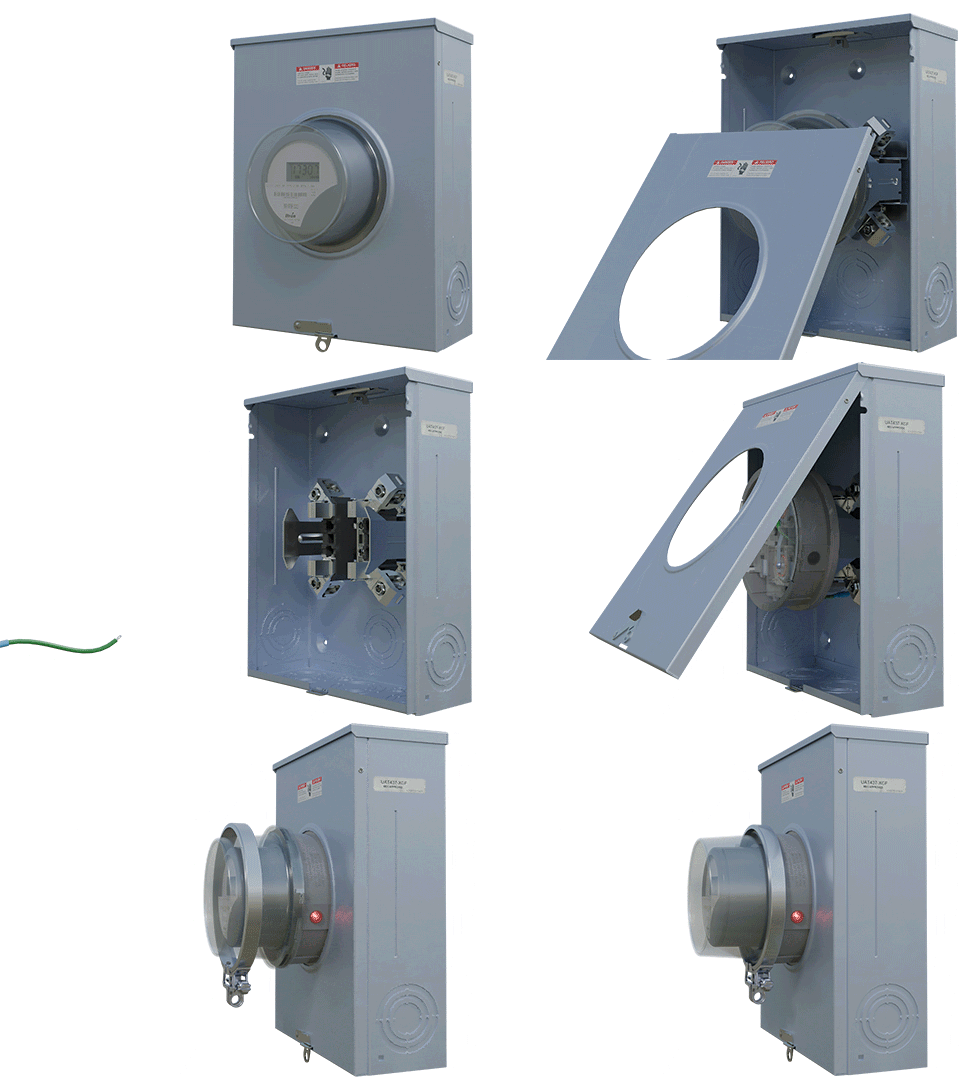
Technical Specifications & Performance Data
Technical specifications for M-Ti's complete meter-based SPD product line. Type 1 surge protection devices with verified 50-60 kA per-phase ratings, true Class 320 current capacity without service derating, 15-year warranties, and the industry's only 3-phase meter solution.
Meter-Based Surge Protection Device Comparison
Meter-Based SPD Market Landscape
Meter-based surge protection devices install directly into utility meter sockets, providing Type 1 protection at the service entrance without panel modifications. As market consolidation continues, M-Ti maintains the industry's most comprehensive product range with verified technical specifications.
50-60 kA
Per Phase Capacity
Surge capacity rated per phase (100-150 kA total) vs. competitor 30-50 kA total ratings
Won't Derate
True Class 320
575-CEB & CL320: 400A Max/320A Continuous maintains full Class 320 service capacity
15 Years
Product Warranty
Industry-leading warranty coverage across all meter-based product lines
Industry-Only
Unique Products
Only 3-phase meter SPD (675-3PAL)
Only low-profile true Class 320 (575-CEB)
Competitive Comparisons:
M-Ti meter-based SPDs: 50-60 kA per phase (100-150 kA total), representing 33-50% higher per-phase surge capacity than competing SPDs. Our 575-CEB and CL320 both carry 400A Max/320A Continuous ratings and will not derate Class 320 meter sockets. The 675-3PAL is the industry's only 3-phase meter-based SPD.
All specifications verified against published manufacturer datasheets. See Technical Standards & Terminology and FAQs below for detailed explanations.

Meter-Based SPD Technical Specifications
Complete comparison of all Meter-Treater meter-based surge protection devices (SPDs). All products are Type 1 SPDs, UL 1449 & UL 414 listed, with 15-year warranties and nanosecond response times.
Need help with terminology? Check the Technical Standards & Terminology section of this page.

400 Series
The Original METER-TREATER®
2.4" Standoff | Since 1986
120kA
Max Surge Current
60kA
per phase
500V
VPR
150V
MCOV [L-G]
320A
260A
2.4"
Installed Depth
1.8 lbs
Weight
4-5
Jaw Blades
2 Red
LED Indicators
10 kA RMS
SCCR
15 Year
Warranty

575 Series
Low Profile Design
1.5" Standoff
120kA
Max Surge Current
60kA
per phase
600V
VPR
150V
MCOV [L-G]
320A
260A
1.5"
Installed Depth
1.25-1.75 lbs
Weight
4-5
Jaw Blades
1 Red
LED Indicators
10 kA RMS
SCCR
15 Year
Warranty

575-CEB
Low Profile Class 320
1.5" Standoff | 400A
120kA
Max Surge Current
60kA
per phase
600V
VPR
180V
MCOV [L-G]
400A
320A
1.5"
Installed Depth
2.25 lbs
Weight
4-5
Jaw Blades
1 Red
LED Indicators
10 kA RMS
SCCR
15 Year
Warranty

675-3PAL
Three-Phase Meter SPD
2.4" Standoff | 3-Phase
150kA
Max Surge Current
50kA
per phase
1000V
VPR
270V
MCOV
250A
200A
2.4"
Installed Depth
2.2 lbs
Weight
7
Jaw Blades
3 Red
LED Indicators
10 kA RMS
SCCR
15 Year
Warranty

CL320
Original Class 320
2.4" Standoff | Heavy-Duty
100kA
Max Surge Current
50kA
per phase
600V
VPR
180V
MCOV [L-G]
400A
320A
2.4"
Installed Depth
2.75 lbs
Weight
4-5
Jaw Blades
1 Red
LED Indicators
10 kA RMS
SCCR
15 Year
Warranty
Common Specifications (All Meter-Based Products): Type 1 SPD | ANSI/UL 1449 & UL 414 Listed | MOV Technology | NEMA 3R Housing | -40°F to +140°F Operating Temperature Range | 47-63 Hz Operating Frequency | Polycarbonate Enclosure with UV Inhibitors | Response Time <2 Nanosecond | 20 kA Repetitive Impulse Rating (Iₙ) | < 95% Noncondensing Relative Humidity
Hardwired Type 1 SPD Alternatives
For applications where meter-based installation is not feasible, M-Ti offers hardwired Type 1/Type 2 SPDs that can be installed within meter socket enclosures (NEMA 3R) or in separate enclosures with appropriate NEMA ratings per NEC requirements.
Installation Configuration Options:
Inside Meter Socket Enclosure: MAP Series installs within existing NEMA 3R meter socket enclosures, providing Type 1 protection without requiring additional enclosure infrastructure. Optional remote LED kit available.
External with Conduit Connection: RCHW Series connects via conduit knockout. When installed external to meter socket, RCHW configuration should meet applicable NEMA ratings per NEC Article 230 (see: RCHW Series NEMA Ratings).
RCHW-PC Configuration: Combines MAP Series compact design with RCHW's comprehensive UL listings and configurable enclosure options.


RCHW Series
Heavy-Duty Configurable SPD
Highly Configurable
Max Surge Current
50-200kA per phase
SCCR
100kA RMS
SPD Type
Type 1 or Type 2
up to 1,200A
Service Current
Housing Options
NEMA 1 - 4X, 12, 13
Enclosure
Aluminum / Polycarbonate
Dry Contacts, Audible Alarm, RF Filtering
Optional Features
<2 Nanosecond
Response Time
Warranty
15 Year
NEC Compliance: When installing hardwired SPDs inside meter socket enclosures, existing NEMA 3R rating typically covers the installation. For external installations with conduit connections, the SPD's housing must meet applicable NEMA ratings per NEC Article 230 for the installation environment.


Technical Standards & Terminology
Reference guide for surge protection device specifications and industry standards.
ANSI/UL 1449
Underwriters Laboratories Standard for surge protective devices. Defines performance requirements, testing procedures, voltage protection ratings, and safety criteria.
Current edition: 5th Edition (2021).
Class 320 (ANSI)
Current classification for meters and meter sockets rated for 320 A continuous duty per ANSI C12.1 (power), 12.10 (meters) and C12.7 (sockets).
Meter sockets rated 320 A continuous duty require SPDs with both 400A Maximum Load Rating and 320A Continuous Rating to maintain full service capacity. Installing an SPD with lower continuous ratings will derate the service to 200-260A continuous, even though the device physically fits.
M-Ti's 575-CEB and CL320 both carry 400A Max/320A Continuous ratings and will not derate Class 320 meter sockets.
→ Read white paper: Understanding Continuous vs. Maximum Ratings
MOV (Metal Oxide Varistor)
Semiconductor surge suppression component utilizing zinc oxide ceramic material.
Provides voltage-dependent resistance: high impedance during normal operation, low impedance during surge events, diverting transient currents to ground.
Type 1 SPD
Surge protective devices installed on line side (utility side) of service equipment main disconnect per UL 1449. Provides whole-facility protection at service entrance.
All M-Ti meter-based products are Type 1 SPDs.
SCCR (Short Circuit Current Rating)
Maximum prospective fault current the device can safely withstand without catastrophic failure. Expressed in kA RMS symmetrical.
All M-Ti meter-based products rated 10 kA RMS, suitable for residential and commercial service entrance applications.
VPR (Voltage Protection Rating)
Maximum voltage let-through measured at the SPD terminals during surge events per UL 1449 testing protocols.
Lower VPR values provide tighter voltage clamping and enhanced protection for sensitive electronic equipment.
ANSI/UL 414
Safety Standard for meter sockets and meter socket adapters.
M-Ti meter-based SPDs carry dual listings (UL 1449 and UL 414), ensuring compliance with both surge protection and meter socket safety requirements.
NEMA Ratings
National Electrical Manufacturers Association enclosure classification system.
NEMA 3R (meter sockets): outdoor rain-resistant.
NEMA 4X: watertight, corrosion-resistant.
Generally, higher numerical ratings indicate increased environmental protection.
Iₙ (Nominal Discharge Current)
Repetitive impulse current rating per UL1449. Indicates SPD ability to withstand repeated surge events. UL Max Iₙ is 20 Ka (the maxium they test).
M-Ti meter-based products rated 20 kA Iₙ, supporting extended operational life in high-exposure environments.
Type 2 SPD
Surge protective devices installed on load side of service disconnect, typically at distribution panels or branch circuits. Provides point-of-use protection for sensitive equipment.
Requires coordination with upstream Type 1 devices.
MCOV (Maximum Continuous Operating Voltage)
Maximum voltage the SPD can withstand continuously without degradation or thermal runaway.
MCOV must exceed nominal system voltage by sufficient margin to prevent nuisance failures during normal voltage variations.
kA (Kiloamperes)
Maximum surge current capacity the device can safely conduct to ground. Measured using 8/20 µs waveform per UL 1449 & IEEE C62.41. Higher kA ratings indicate greater surge energy handling capability and extended operational life under repeated surge conditions.
Note: Always verify whether ratings are per-phase or total.
Frequently Asked Questions
What distinguishes meter-based SPDs from panel-mounted devices?
Meter-based SPDs install directly into the utility meter socket, providing Type 1 protection at the service entrance point without requiring panel modifications or additional enclosures. This installation method simplifies retrofits, reduces labor costs, and provides first-line whole-facility protection at the utility interconnection point. Panel-mounted devices require breaker space, internal panel work, and typically provide Type 2 protection on the load side of the main disconnect.
Can hardwired SPDs be installed inside meter socket enclosures?
Yes. The MAP Series provides compact form factor suitable for installation within NEMA 3R meter socket enclosures, maintaining the enclosure's environmental rating while providing Type 1 protection without requiring separate SPD enclosure. For installations requiring conduit connections through knockouts, specify RCHW Series with appropriate NEMA-rated enclosures per NEC Article 230 requirements for the installation environment.
How do I select between 575 Series and 575 CEB?
Both products offer 120 kA surge capacity and 1.5" low-profile installation. Select 575 Series for standard residential and light commercial applications up to 260A continuous service. Select 575-CEB for Class 320 meter sockets or applications requiring 320A continuous rating (400A max load rating); the 575-CEB will not derate a 320A meter socket, making it appropriate for larger residential installations or commercial facilities with high service entrance current requirements.
When is the 675-3PAL required versus single-phase models?
The 675-3PAL is specified for 3-phase electrical service (120/240V AC 3-phase, 200A continuous). It provides 150 kA total surge capacity (50 kA per phase) with 7 jaw blades and independent LED status indicators for each phase. This product addresses commercial and light industrial applications with 3-phase power distribution requirements where single-phase meter-based SPDs cannot be applied.
Does it work with Solar installation?
Yes. It does not interfere with normal solar installation operation. For Complete Solar Surge Protection, see www.metertreater.com/solar
Will it disconnect my power if the SPD is overloaded and disconnects itself?
No. Only the surge protection elements of the SPD disconnect. The power remains "on" to the building/facility.
What is the difference between SCCR and maximum surge current?
SCCR (Short Circuit Current Rating) measures the device's ability to safely disconnect from the utility system, expressed in kA RMS symmetrical. Maximum surge current (8/20 µs) measures transient surge energy handling capacity. These are distinct electrical characteristics: SCCR addresses sustained fault conditions, while surge current addresses transient overvoltage events. M-Ti meter-based products provide 10 kA SCCR and 100-150 kA maximum surge current ratings.

